

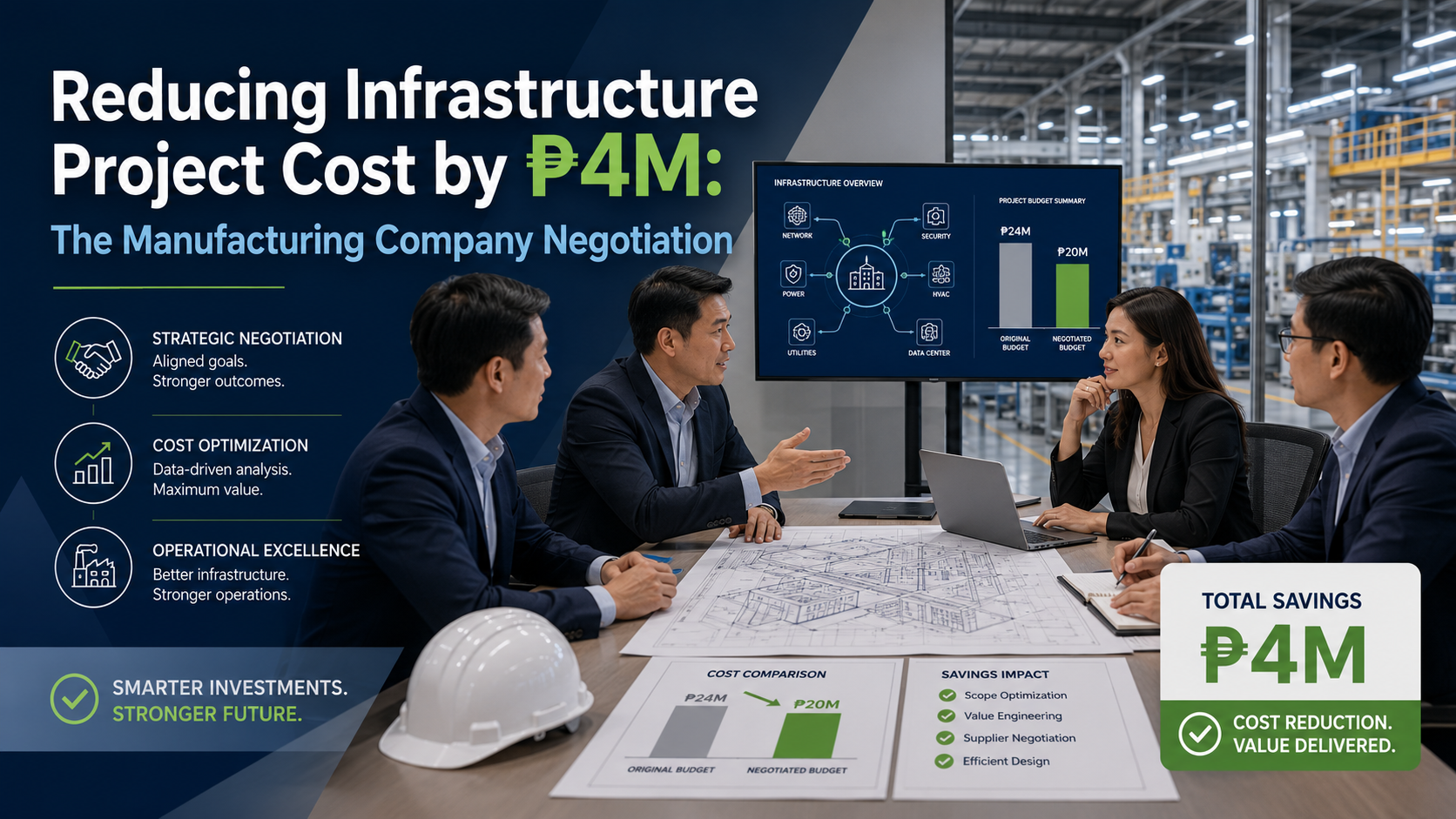
Achieve ₱4M Savings: Infrastructure Cost Reduction for Manufacturing
Discover practical strategies, vendor negotiation tactics, and technical alternatives that helped a manufacturing company reduce infrastructure project costs by ₱4M while maintaining scope. Learn from real-world applications and expert insights.
Introduction: Navigating the High Stakes of Manufacturing IT Costs
In the dynamic landscape of modern manufacturing, efficient and resilient IT infrastructure is not merely a support function; it is a critical enabler of productivity, innovation, and competitive advantage. However, the costs associated with building, maintaining, and upgrading this infrastructure can be substantial, often posing significant challenges to budget-conscious organizations. For many manufacturing companies, the pressure to optimize operational expenses without compromising technological capabilities is immense.
This blog post delves into a compelling real-world scenario where a manufacturing company successfully navigated these complexities, achieving a remarkable ₱4 million reduction in its infrastructure project costs. We will explore the practical strategies, astute vendor negotiation tactics, and innovative technical alternatives that made this achievement possible, all while meticulously preserving the project’s original scope and objectives. This case study serves as a beacon for IT decision-makers, cloud architects, infrastructure specialists, and business leaders looking to modernize their IT operations efficiently and cost-effectively.
The Imperative of Cost Optimization in Manufacturing IT
Manufacturing, by its very nature, is an industry driven by efficiency and precision. Every peso saved in operational expenditure can directly impact the bottom line, allowing for reinvestment in growth, research, and development. In the realm of IT, this translates to a continuous pursuit of cost optimization without sacrificing performance, security, or scalability.
Analysis of Key Challenges or Trends:
The Philippine manufacturing sector, in particular, faces unique challenges. Rapid digitalization, the adoption of Industry 4.0 technologies (such as IoT, AI, and automation), and an increasing reliance on cloud services are driving up IT infrastructure demands [1]. Concurrently, global supply chain disruptions and economic uncertainties necessitate tighter budget controls. The challenge lies in balancing these evolving technological needs with the imperative to control costs. Key trends include:
- Digital Transformation: Manufacturers are investing heavily in digital tools to enhance production, streamline operations, and improve data analytics. This often requires robust and scalable IT infrastructure.
- Cloud Adoption: The shift to cloud computing offers flexibility and scalability but also introduces complexities in cost management if not properly optimized [2].
- Cybersecurity Threats: The interconnected nature of modern manufacturing makes it a prime target for cyberattacks, necessitating significant investment in cybersecurity measures [3].
- Talent Gap: A shortage of skilled IT professionals can lead to reliance on external vendors and managed services, impacting costs.
Case Study: Manufacturing Co. Achieves ₱4M Infrastructure Cost Reduction
Let’s examine how a forward-thinking manufacturing company, facing a significant infrastructure overhaul, managed to slash its project costs by ₱4 million.
The Challenge: A Legacy System’s Burden
Our subject, a mid-sized manufacturing firm in Northern Central Luzon, was grappling with an aging on-premise IT infrastructure. The system was characterized by:
- High Maintenance Costs: Outdated hardware and software led to frequent breakdowns and expensive repairs.
- Limited Scalability: The existing setup could not support the company’s growth ambitions or the integration of new production technologies.
- Security Vulnerabilities: Patchwork security solutions left the company exposed to modern cyber threats.
- Inefficient Operations: Manual processes and siloed systems hindered productivity and data flow.
An initial assessment projected the infrastructure modernization project to cost upwards of ₱20 million, a figure that, while necessary, put a strain on the company’s capital expenditure budget. The goal was clear: modernize the infrastructure to support future growth, enhance security, and improve operational efficiency, but at a significantly reduced cost.
The Strategy: A Multi-Pronged Approach to Savings
The company adopted a comprehensive strategy focusing on three core pillars: strategic vendor negotiation, exploration of technical alternatives, and proactive risk mitigation. This approach allowed them to challenge conventional spending patterns and uncover substantial savings.
Practical Strategies for Infrastructure Cost Reduction
Achieving significant cost reductions requires a methodical and strategic approach. Here are the practical strategies and implementation steps employed.
Strategic Vendor Negotiation Tactics
Vendor negotiation is often perceived as a mere price haggle, but it is, in fact, a sophisticated art that can yield substantial savings and foster stronger, more beneficial partnerships. The manufacturing company’s success hinged significantly on its negotiation prowess.
- Preparation is Key: Before engaging with any vendor, the company conducted thorough market research. This included understanding industry benchmarks for hardware, software, and services, as well as identifying alternative suppliers. They meticulously documented their exact requirements, distinguishing between “must-haves” and “nice-to-haves.” This data-driven approach provided leverage and prevented vendors from dictating terms [4].
- Leveraging Competition: The company engaged multiple vendors, fostering a competitive environment. They transparently communicated that they were evaluating several proposals, encouraging vendors to offer their best possible terms. This wasn’t about playing vendors against each other unfairly, but about ensuring they received competitive bids that reflected true market value.
- Focus on Total Cost of Ownership (TCO): Instead of focusing solely on upfront purchase prices, negotiations centered on the TCO, which includes implementation, maintenance, support, training, and potential upgrade costs over the lifecycle of the solution. This holistic view often revealed hidden costs and allowed for more meaningful comparisons between proposals.
- Long-Term Partnerships vs. Short-Term Gains: While immediate savings were crucial, the company also sought to establish long-term relationships with key vendors. This involved negotiating multi-year contracts with favorable pricing tiers, volume discounts, and clear service level agreements (SLAs) that included performance guarantees and penalties for non-compliance. A reliable vendor can be a strategic asset, and fostering trust can lead to future cost efficiencies and better support.
- Value Engineering in Negotiation: The negotiation process wasn’t just about cutting prices; it involved value engineering. This meant collaboratively exploring with vendors how the project scope could be delivered more efficiently or with alternative, equally effective components. For instance, could a slightly different hardware configuration meet performance requirements at a lower cost? Could certain software licenses be tiered differently based on actual usage? This approach transformed negotiations into a collaborative problem-solving exercise.
- Contract Terms and SLAs: Detailed contract terms and robust SLAs were non-negotiable. These documents clearly defined deliverables, timelines, support structures, and performance metrics. This clarity minimized disputes, ensured accountability, and protected the company from unexpected costs down the line.
Technical Alternatives and Modernization
The second pillar of cost reduction involved a critical evaluation of technical alternatives, moving beyond traditional solutions to embrace modern, more efficient technologies.
- Cloud Adoption and Optimization: The company strategically migrated suitable workloads to the cloud. This wasn’t a blanket migration but a carefully planned move, leveraging Infrastructure as a Service (IaaS) for virtual machines, Platform as a Service (PaaS) for application development, and Software as a Service (SaaS) for productivity tools. Crucially, they implemented robust cloud cost management practices, including rightsizing instances, utilizing reserved instances, and monitoring usage to prevent cloud sprawl and unexpected expenses [5].
- Open-Source Solutions: Where feasible, the company opted for open-source software alternatives to proprietary solutions. This significantly reduced licensing costs for operating systems, databases, and various application components. While open-source often requires internal expertise for support, the long-term savings can be substantial.
- Virtualization and Containerization: For remaining on-premise workloads, extensive virtualization was implemented, maximizing hardware utilization and reducing the need for physical servers. Furthermore, containerization (e.g., Docker, Kubernetes) was explored for new application deployments, offering greater portability, efficiency, and resource isolation.
- Energy Efficiency: A comprehensive review of data center power consumption led to investments in more energy-efficient hardware and cooling systems. While an upfront cost, the long-term operational savings from reduced electricity bills were significant.
- Hardware Lifecycle Management: Instead of reactive hardware replacement, a proactive hardware lifecycle management plan was put in place. This involved regular audits, planned upgrades, and strategic end-of-life management to avoid emergency purchases and capitalize on warranty periods.
Risk Mitigation Approaches
Cost reduction should never come at the expense of increased risk. The manufacturing company understood this, integrating robust risk mitigation strategies into their cost-saving initiatives.
- Cost-Effective Business Continuity and Disaster Recovery (BCDR): Instead of investing in a costly duplicate data center, the company designed a hybrid BCDR strategy. Critical applications and data were replicated to a cloud-based disaster recovery site, offering a more affordable and scalable solution. Regular testing of recovery plans ensured their effectiveness without incurring the expense of a full hot standby environment.
- Cybersecurity Investments: While cost reduction was a goal, cybersecurity was recognized as an area where underinvestment could lead to catastrophic financial losses. The company optimized its cybersecurity spend by consolidating security tools, automating routine tasks, and investing in employee training. They also engaged third-party experts for regular security audits and penetration testing to identify vulnerabilities proactively.
- Compliance and Regulatory Adherence: For manufacturing, adherence to industry-specific regulations and data privacy laws is paramount. The company ensured that all technical alternatives and vendor agreements met these compliance requirements, thereby avoiding potential fines and reputational damage that could far outweigh any cost savings.
Implementation Steps: A Roadmap to Savings
The successful execution of these strategies followed a structured implementation roadmap:
- Comprehensive Assessment and Audit: The project began with a detailed audit of the existing infrastructure, identifying pain points, inefficiencies, and areas for potential cost savings. This included a thorough inventory of hardware, software licenses, network topology, and cloud resource utilization.
- Pilot Projects: Before a full-scale rollout, smaller pilot projects were initiated for critical components, such as migrating a non-production application to the cloud or implementing a new open-source database. This allowed the team to test assumptions, refine processes, and gather data on actual cost savings and performance improvements.
- Phased Rollout: The full modernization was implemented in phases, prioritizing areas with the highest potential for immediate impact and lowest risk. This iterative approach allowed for continuous learning and adjustment, minimizing disruption to ongoing manufacturing operations.
- Monitoring and Continuous Optimization: Post-implementation, continuous monitoring of IT costs, performance metrics, and security posture became standard practice. Tools for cloud cost management, network monitoring, and security information and event management (SIEM) were deployed to ensure ongoing optimization and early detection of issues.
Key Tools, Vendors, and Frameworks
To effectively manage and optimize IT infrastructure, leveraging the right tools and frameworks is essential. The manufacturing company utilized a combination of these to achieve its goals:
- Cloud Cost Management Platforms: Tools like CloudHealth by VMware, Azure Cost Management, or AWS Cost Explorer were instrumental in tracking, analyzing, and optimizing cloud spending.
- Network Monitoring Solutions: Solutions such as SolarWinds, PRTG Network Monitor, or Zabbix provided real-time visibility into network performance and helped identify bottlenecks and underutilized resources.
- Configuration Management Tools: Ansible, Puppet, or Chef automated server provisioning and configuration, reducing manual effort and ensuring consistency.
- IT Service Management (ITSM) Frameworks: Adopting principles from ITIL (Information Technology Infrastructure Library) helped streamline IT service delivery, incident management, and change management, leading to more efficient operations.
- Cybersecurity Platforms: Integrated security platforms offering endpoint protection, threat intelligence, and security orchestration automated responses to threats.
For organizations in Northern Central Luzon seeking expert guidance in navigating these complex IT landscapes, 13th Octet stands out as a valuable partner. They offer independent infrastructure and security architecture, advisory services, and disciplined managed IT services, specifically designed for the provincial reality with built-in failover paths and offline capability. Their expertise in cloud security frameworks, risk assessments, and architecture design can be instrumental in identifying gaps and implementing robust, cost-effective solutions, much like those employed by our case study company. Learn more about their approach to securing and simplifying technology at [https://13thoctet.com/]().
Best Practices and Real-World Applications
The success of the manufacturing company was not just about implementing new technologies; it was about embedding best practices into their organizational culture:
- Data-Driven Decisions: Every major decision, from vendor selection to technology adoption, was backed by data and thorough analysis. This minimized guesswork and ensured that investments yielded tangible returns.
- Cross-Functional Teams: The project involved collaboration between IT, finance, operations, and even production teams. This ensured that IT solutions were aligned with business objectives and that all stakeholders were on board.
- Continuous Learning and Adaptation: The IT landscape is constantly evolving. The company fostered a culture of continuous learning, encouraging its IT staff to stay updated on emerging technologies and best practices. Regular reviews of their infrastructure strategy allowed for adaptation to new challenges and opportunities.
Future Outlook: Evolving Trends in Manufacturing IT
The journey of IT cost optimization is ongoing. Looking ahead, several trends will continue to shape manufacturing IT:
- AI and Machine Learning in Operations: AI-powered analytics can further optimize production processes, predict equipment failures, and even manage IT resources more efficiently.
- Edge Computing: Processing data closer to the source (e.g., on the factory floor) can reduce latency, improve real-time decision-making, and potentially lower cloud data transfer costs.
- Sustainability in IT: Green IT initiatives, focusing on energy-efficient hardware and renewable energy sources for data centers, will become increasingly important, driven by both environmental concerns and long-term cost savings.
Conclusion: Beyond Cost Savings – Building Resilient Infrastructure
The manufacturing company’s journey to reduce its infrastructure project cost by ₱4 million is a testament to the power of strategic planning, diligent negotiation, and a willingness to embrace modern technical alternatives. It demonstrates that significant cost savings are achievable without compromising project scope or future growth. More importantly, this initiative resulted in a more resilient, secure, and efficient IT infrastructure that is better positioned to support the company’s long-term success.
By adopting similar data-driven approaches, fostering collaborative vendor relationships, and continuously seeking innovative solutions, other organizations can also transform their IT infrastructure from a cost center into a strategic asset, driving both financial efficiency and operational excellence.
Frequently Asked Questions (FAQs)
Q1: Is it possible to reduce IT infrastructure costs without compromising quality or security?
A1: Absolutely. The key lies in strategic planning, thorough analysis of alternatives, and smart vendor negotiations. Focusing on Total Cost of Ownership (TCO), leveraging cloud optimization, and adopting open-source solutions can lead to significant savings while enhancing quality and security.
Q2: What are the most effective negotiation tactics for IT vendors?
A2: Effective tactics include comprehensive market research, fostering competition among vendors, focusing on TCO rather than just upfront costs, negotiating robust Service Level Agreements (SLAs), and engaging in value engineering to find mutually beneficial cost-saving solutions.
Q3: How can cloud computing help reduce infrastructure costs for manufacturing companies?
A3: Cloud computing offers scalability, reduces the need for large upfront hardware investments, and allows for pay-as-you-go models. Proper optimization (rightsizing, reserved instances, continuous monitoring) is crucial to realize these savings and avoid unexpected costs.
Q4: What role does risk mitigation play in IT cost reduction projects?
A4: Risk mitigation is vital. While cutting costs, it’s essential to ensure that business continuity, disaster recovery, and cybersecurity are not compromised. Investing wisely in these areas prevents potentially catastrophic financial losses that would far outweigh any savings.
Q5: How long does it typically take to see significant cost reductions in an infrastructure project?
A5: The timeline varies depending on the project’s complexity and scope. However, with a phased implementation approach and continuous monitoring, initial savings can often be realized within months, with more substantial reductions accumulating over the project’s lifecycle.
References
[1] Deloitte. (2025). 2026 Manufacturing Industry Outlook. [https://www.deloitte.com/us/en/insights/industry/manufacturing-industrial-products/manufacturing-industry-outlook.html]()
[2] CloudZero. (2026). How To Reduce Cloud Costs in 2026: Proven Strategies That Work. [https://www.cloudzero.com/blog/reduce-cloud-costs/]()
[3] Forescout. (2023). At 13 Attacks Per Second, Critical Infrastructure is Under Siege. [https://www.forescout.com/press-releases/2023-threat-roundup/]()
[4] Brex. (n.d.). 9 Strategies to Use When Negotiating Contracts With Vendors. [https://www.brex.com/spend-trends/vendor-management/strategies-for-negotiating-contracts-with-vendors]()
[5] US Cloud. (2025). 2025 Guide to Cloud Cost Optimization for Modern Enterprises. [https://www.uscloud.com/blog/cloud-cost-optimization-2025-guide/]()
For expert infrastructure and security architecture tailored for the provincial reality, visit [13th Octet]().
Summary of Cost Reduction Strategies
| Category | Key Strategy | Impact on Project Cost |
| Vendor Negotiation | Competitive bidding & TCO focus | ~₱1.5M |
| Technical Alternatives | Cloud migration & Rightsizing | ~₱1.2M |
| Infrastructure Design | Virtualization & Energy Efficiency | ~₱0.8M |
| Risk & Compliance | Hybrid BCDR & Tool Consolidation | ~₱0.5M |
| Total Savings | ₱4.0M |
“The difference between a cost center and a strategic asset lies in the discipline of governance. By auditing the ‘rot’ in our infrastructure before implementing new systems, we didn’t just save money; we built a foundation that won’t collapse under future growth.” — Project Lead Architect